Imagine leaving your office on a Friday afternoon. By the time you have finished dinner with your family, a cybercriminal has identified a vulnerability in your company's technology infrastructure, gained administrative access and begun exploring your confidential business information.
The criminal may have accomplished much of this without touching a keyboard.
On November 13, the Federal Bureau of Investigation issued a FLASH advisory concerning ARTEX, an artificial intelligence-powered penetration testing framework that has been repurposed by cybercriminals and nation-state threat actors to conduct offensive cyber operations. [1]
The emergence of ARTEX represents something more consequential than the introduction of another hacking tool. It represents a change in the industrial capacity of our adversaries, with implications for how businesses manage technology risk, protect their operations and purchase insurance.
From automation to autonomy
For decades, cybercriminals have used automation to identify vulnerable computer systems. What distinguishes this emerging generation of offensive technology is its ability to make decisions based on what it discovers.
ARTEX is built around a concept known as agentic AI. Rather than simply responding to questions or generating content, AI agents are given objectives, provided access to tools and allowed to perform tasks with varying degrees of autonomy.
Think of ARTEX as a digital team of cybersecurity specialists. One member coordinates the operation, while others independently investigate different aspects of an organization's technology environment. They share their discoveries, evaluate their progress and adjust their activities accordingly.
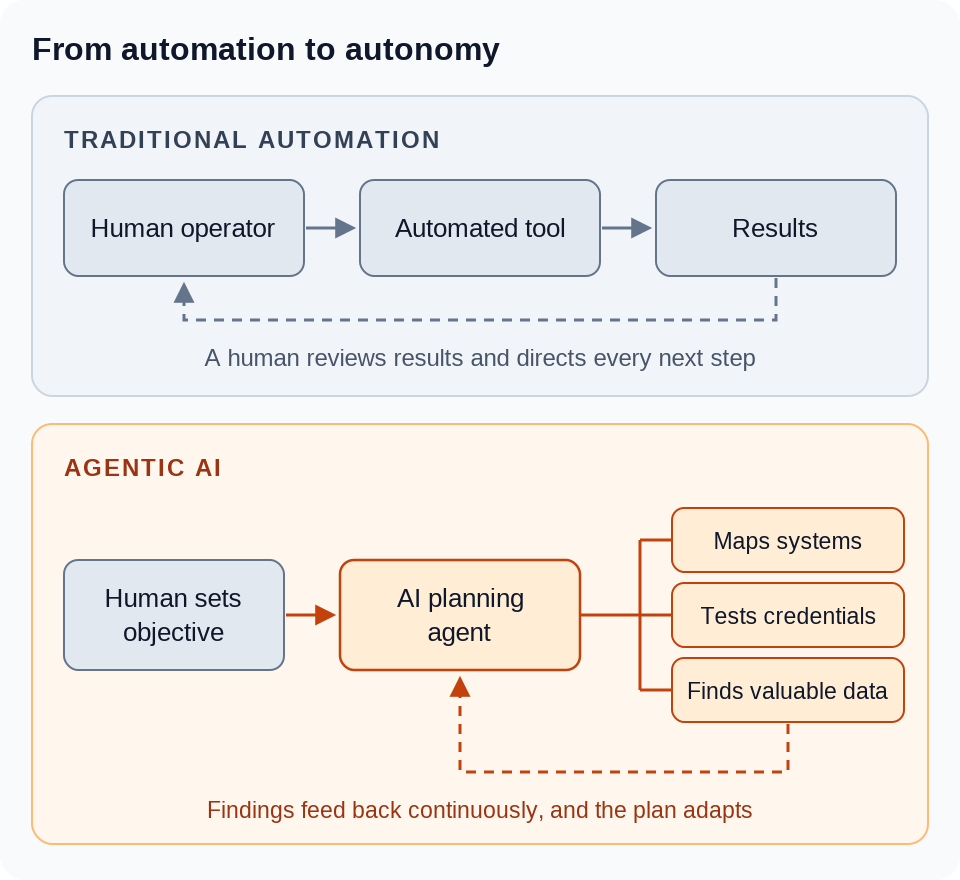
Figure 1. A simplified comparison. In traditional automation, a person decides each next step. In agentic AI, a person sets the objective and the agents decide how to pursue it.
Much of the underlying hacking technology already exists. The innovation lies in the ability to coordinate its use with considerably less human intervention.
For malicious actors, this creates three distinct advantages: speed, scale and reduced operating costs.
The changing economics of cybercrime
Historically, sophisticated cyber operations required considerable investments in human capital. Identifying vulnerabilities, navigating unfamiliar technology environments and overcoming security controls required time and technical expertise.
Like any business, financially motivated criminal organizations must weigh the cost of an operation against its potential return.
Artificial intelligence is changing that calculation.
If a criminal organization can simultaneously investigate hundreds of businesses with limited human involvement, the economic justification for targeting smaller organizations becomes stronger.
A regional manufacturer, an independent insurance agency, an automotive dealership or a small medical practice may not have historically justified the investment of a dedicated team of hackers.
They may now justify the relatively marginal cost of an AI-powered investigation.
Nation-state adversaries benefit from many of the same efficiencies. However, their objectives can extend beyond financial gain to industrial espionage, intelligence collection, disruption of critical infrastructure and the establishment of persistent access to strategically important organizations.
A small business need not be strategically important itself. Its relationship with another organization may make it valuable.
The threat is no longer theoretical
Recent incidents provide insight into how these capabilities are being employed in practice.
The nation-state campaign
In October 2026, Microsoft disclosed an ARTEX-enabled campaign attributed to Storm-0940, a China-aligned threat actor. [2]
The compromise of application credentials associated with ConnectWise Cloud Backup allowed the attackers to attempt access to more than 2,250 downstream Microsoft customer environments.
In some cases, the attackers established additional privileged access that could potentially survive the removal of the originally compromised application.
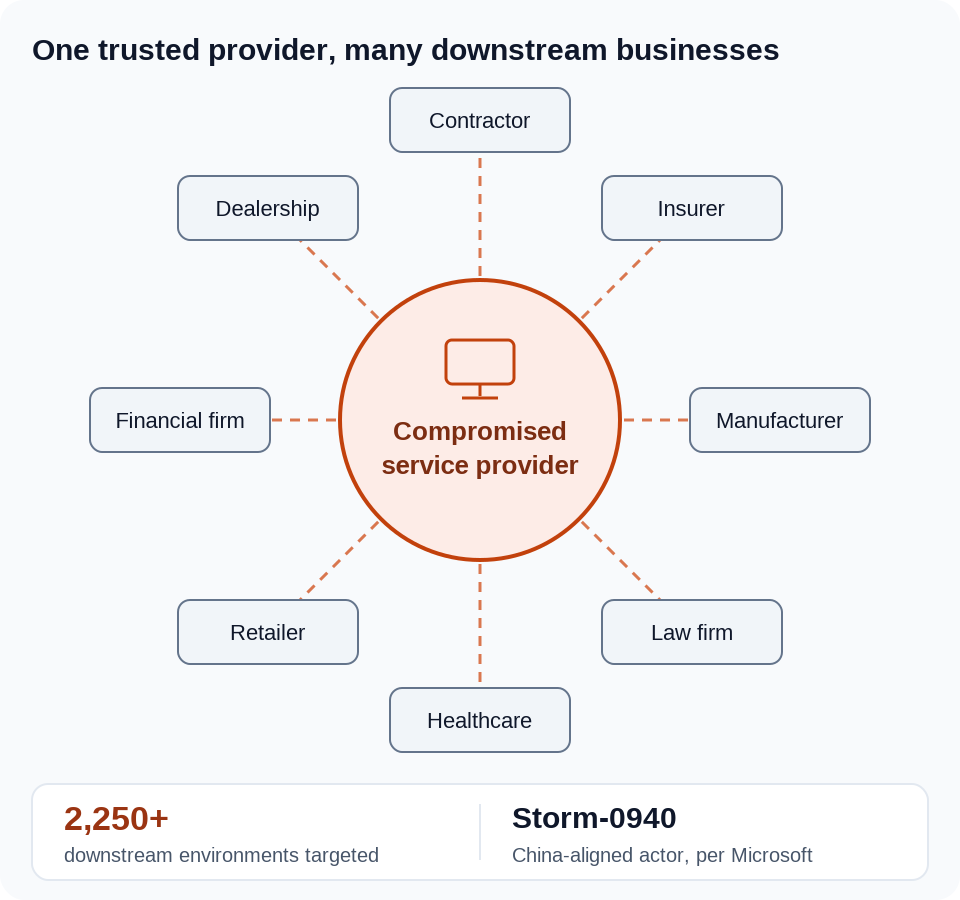
Figure 2. How one trusted provider can become a path into many customers. The business types shown are illustrative; the 2,250+ figure and attribution are from Microsoft's disclosure.
The significance of this incident extends beyond ConnectWise. It demonstrates how the digital trust that exists between businesses and their technology providers can be weaponized at scale.
The financially motivated campaign
In November, cybersecurity provider Barracuda disclosed an intrusion that began with a cloud access credential previously issued to a third-party vendor. When the vendor's project had concluded, the credential remained active. [3]
The attacker obtained that credential and used AI-assisted capabilities consistent with ARTEX to expand its access. Over approximately 44 hours, the intrusion reached multiple technology platforms and roughly ten cloud accounts.
By the time the suspicious activity was reported, the attacker's observed activity had already concluded.
Even organizations whose core business is cybersecurity are susceptible to this emerging threat.
Cybercrime that finances itself
Amazon Threat Intelligence has also documented ARTEX-enabled criminal campaigns targeting credentials used to access commercial artificial intelligence services. [4]
Stolen credentials were used to fund the computing resources needed to search for additional credentials, effectively transferring the operating costs of the criminal enterprise to its victims.
For businesses adopting AI, the financial exposure associated with stolen technology credentials now extends well beyond unauthorized access to confidential information.
The forgotten corners of your business
Organizations naturally concentrate their cybersecurity investments around their most important technology assets.
Their primary financial systems, employee computers and business-critical applications are often relatively well protected.
But what about the customer portal developed several years ago? The remote access connection installed by a former contractor? The software integration that is no longer being used?
Businesses accumulate digital infrastructure much as they accumulate physical infrastructure. Over time, some of it becomes neglected.
An AI-powered adversary does not necessarily share the assumptions or priorities of the organization it is investigating. An obscure application may receive as much attention as a company's primary website.
This makes the completeness of an organization's cybersecurity program increasingly important.
The vulnerability that ultimately compromises your business may exist in a system you have forgotten you own.
Rethinking the speed of cybersecurity
Many organizations have built their cybersecurity programs around the ability to detect malicious activity and then respond to it.
That remains important. However, when attackers can progress through multiple stages of an intrusion in minutes or hours, the time available for human intervention becomes increasingly limited.
Consider an organization whose IT provider receives a security alert at 11 p.m. on a Saturday. If the alert requires manual investigation, management approval or escalation to another service provider, several hours may pass before meaningful action is taken.
During that time, an autonomous attacker can continue operating.
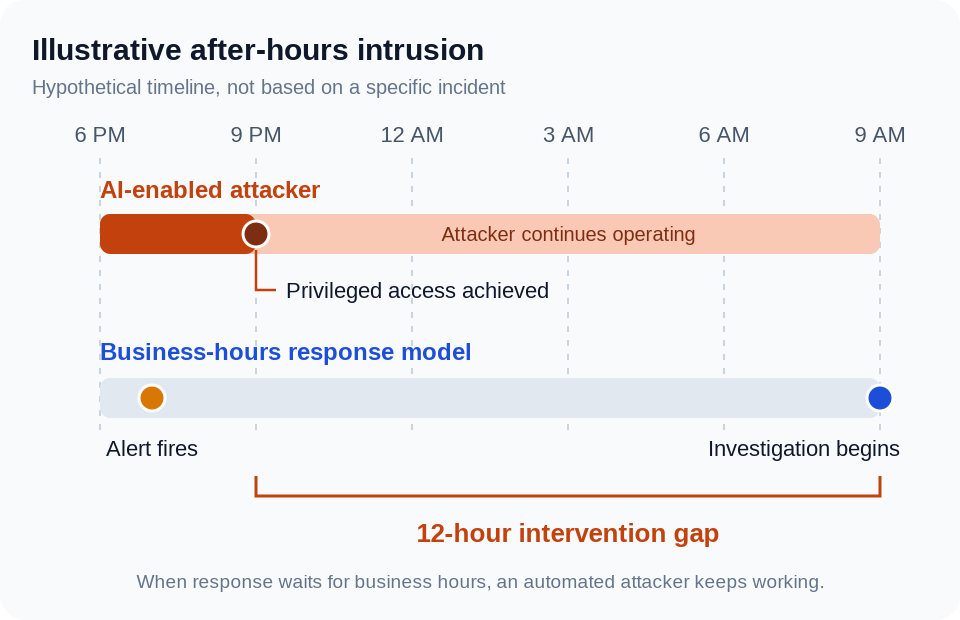
Figure 3. A hypothetical illustration of the gap between machine-speed attacks and business-hours response. It is not drawn from any specific incident.
This creates an operational mismatch between the speed of the threat and the speed of the organization's response.
Businesses must increasingly invest in security controls that prevent unauthorized activity, automatically contain certain threats and limit the damage an attacker can inflict if initial defenses fail.
This is not necessarily about buying more cybersecurity technology. It is about ensuring that the technology, personnel and procedures already in place work together effectively.
Six questions every business leader should be asking
Business owners and executives do not need to become cybersecurity engineers. They do, however, need to understand whether their organizations are prepared for this changing risk landscape.
The following questions provide a starting point for discussions with internal technology teams and managed IT service providers.
1. Do we know everything we expose to the internet?
Maintain an up-to-date inventory of internet-facing systems. Remove unnecessary exposure, retire obsolete applications and prioritize the remediation of vulnerabilities that are actively being exploited.
2. Who and what has access to our business?
Review the permissions granted to employees, vendors, software applications and automated services. Remove outdated credentials, implement phishing-resistant multifactor authentication where possible and limit the privileges granted to each identity.
Remember that software applications often have their own digital identities. Protecting employee accounts alone is insufficient.
3. Who is protecting our business at two in the morning?
Understand whether your cybersecurity monitoring operates around the clock and whether responders have the authority to contain a credible threat without waiting for normal business hours.
There is an important distinction between 24-hour monitoring and 24-hour response.
4. How much damage could a single compromised account cause?
Require appropriate separation between critical systems, restrict administrative privileges and implement controls that prevent one compromised identity from providing unrestricted access to the entire organization.
5. How quickly could we recover?
Maintain isolated or immutable backups, regularly test restoration procedures and develop the ability to revoke compromised credentials and restore trusted technology environments.
Having a backup is not the same as having a demonstrated ability to recover.
6. Does our cyber insurance reflect our actual exposure?
Discuss emerging risks with your insurance advisor, including third-party compromises, dependent business interruption, data extortion, unauthorized cloud computing expenses and the costs associated with investigating and restoring compromised technology environments.
Coverage for these events varies considerably depending on policy language, limitations, exclusions and endorsements.
The implications for cyber insurance
The emergence of autonomous offensive capabilities deserves attention from both businesses and the insurance industry.
From an insurance perspective, AI-assisted cybercrime has the potential to affect three fundamental dimensions of risk: the frequency of losses, the severity of individual losses and the accumulation of losses across multiple insured organizations.
A single compromised software provider may create exposure for hundreds or thousands of businesses connected to its services.
As these risks evolve, businesses should avoid assuming that all losses resulting from an AI-enabled cyberattack will automatically fall within the scope of their cyber insurance policies.
Nation-state involvement also raises important coverage questions concerning state-backed cyberattack exclusions and attribution requirements. The involvement of a government-affiliated threat actor does not, by itself, establish that a particular insurance exclusion applies.
Cyber insurance remains an important component of financial resilience, but it is most effective when supported by a comprehensive loss prevention and recovery strategy.
Preparing for a different kind of adversary
ARTEX will not be the last technology of its kind.
New offensive AI frameworks will emerge, existing products will improve and the economics of conducting sophisticated cyber operations may continue to favor attackers.
Fortunately, businesses do not need to anticipate every new hacking tool to meaningfully reduce their risk.
They can reduce their digital attack surface. They can better manage the trust they extend to other organizations. They can automate appropriate defensive actions and improve their ability to recover from an incident.
The objective is not to build an impenetrable organization. It is to make successful attacks more difficult, limit their consequences and preserve the ability of the business to operate.
The question business leaders should be asking is not whether artificial intelligence will change cybercrime.
It already has.
The question is whether their businesses are adapting at a comparable speed.
Sources and further reading
- FBI, FLASH-20261113-001: Threat Overview of ARTEX Autonomous Penetration Testing Framework, November 13, 2026.
- Microsoft Threat Intelligence, AI-driven, large-scale nation-state campaign using ARTEX enables supply chain compromise, October 21, 2026.
- Barracuda, Forty-four hours: Anatomy of a machine-speed intrusion, November 11, 2026.
- Amazon Threat Intelligence, Threat actors running cybercrime campaigns with ARTEX AI agents, November 13, 2026.
This article is general risk-management commentary. It is not a coverage opinion, and coverage for any loss depends on the specific policy wording, facts and applicable law.