A cyberattack against connected refrigeration systems is a reminder that the line between cyber risk and property loss is thinner than many executives assume. When remote controllers are exposed and compromised, the resulting damage may not begin with stolen data. It may begin with spoiled food, stressed equipment, business interruption, and a claims dispute over which policy was supposed to respond.
That is the important lesson in a French national cybersecurity bulletin concerning remote refrigeration controllers. The incident is a useful case study because it compresses the full cyber-risk chain into something every operator understands: connected equipment, unauthorized access, physical consequences, financial loss, and uncertainty about recovery.
What CERT-FR actually confirmed
CERT-FR issued alert CERTFR-2026-ALE-012 on October 12 and updated it on October 13. The agency said it was aware of numerous compromises affecting remote refrigeration installation controllers.
The bulletin specifically identified:
- Copeland xweb
- Danfoss AK-SC
- Danfoss AK-SM
- Dixell xweb
CERT-FR warned that exposing management interfaces directly to the internet is contrary to good practice. It also indicated that attack campaigns were likely still ongoing. Its recommended response included removing public exposure, validating configuration, applying vendor-recommended security measures, and restoring access only through a secure VPN or other protected network.
These are the confirmed facts. They do not, by themselves, establish a particular retailer count, inventory loss, claim value, or coverage result. Those questions require evidence from each affected operation.
One detail is especially important for risk and insurance leaders. When advising operators to cut internet telemetry to a refrigeration service provider while taking systems out of danger, CERT-FR also directed them to check their insurance contract conditions. That is a practical reminder that incident response can change monitoring, service, and notification arrangements at the same time that it reduces technical risk.
Why refrigeration controllers became the weak link
Refrigeration controllers are operational technology. They may regulate temperature, defrost cycles, alarms, and communication with a service provider. They are not conventional office computers, but they can be remotely reachable, operationally important, and connected to the systems people rely on to keep food within safe temperature ranges.
That combination creates a familiar security problem. An interface introduced for convenience or remote maintenance can become an entry point into a process that affects physical equipment and perishable inventory.
The relevant control is not simply whether the controller has a password. The broader questions are more useful:
- Is the management interface exposed to the public internet?
- Is remote service access limited to a secure VPN or protected network?
- Are default credentials, firmware, and security settings current?
- Can the operator identify which systems are connected to the controller?
- Can the refrigeration process continue safely if remote access is removed?
- Are configuration changes logged and independently reviewed?
A secure design does not eliminate every operational failure. It does reduce the number of ways an outside actor can turn a digital weakness into a physical disruption.
When cyber risk turns into property loss
The attack-to-loss chain can be stated plainly:
Exposed remote access
→ Compromise of a refrigeration controller
→ Unauthorized configuration changes or operational disruption
→ Temperature excursions, defrost-cycle issues, or equipment stress
→ Spoilage of perishable inventory
→ Store disruption, cleanup, replenishment, and possible downtime
→ Insurance review across cyber, property, equipment breakdown, spoilage, and business interruption
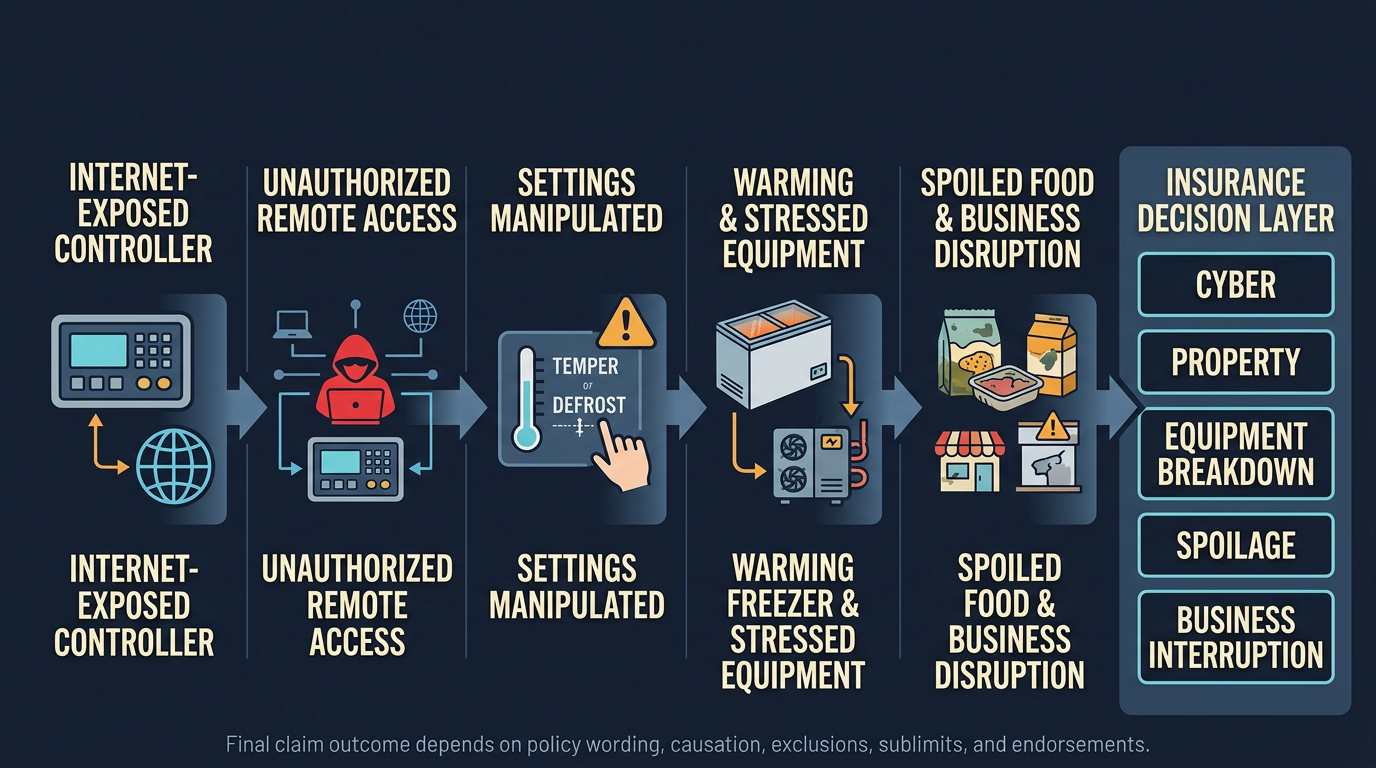
Figure 1. A practical risk sequence. The final claim outcome depends on policy wording, causation analysis, exclusions, sublimits, and endorsements.
The sequence includes both observed facts and reasonable operational inference. CERT-FR confirmed compromises of exposed refrigeration controllers. The likely consequences for a specific business depend on what changed, how the equipment responded, what inventory was affected, and what records exist to connect the incident to the loss.
That distinction matters. A temperature excursion may be consistent with a controller compromise, but a claim still needs a careful causation analysis. Investigators may need controller logs, alarm histories, maintenance records, inventory records, technician reports, and evidence of when the exposure was discovered and contained.
The coverage puzzle: cyber, property, spoilage, or equipment breakdown?
If a refrigeration control system is compromised and the result is spoiled stock and interrupted operations, which coverage is actually supposed to respond?
There is no universal answer. The analysis depends on the facts, policy wording, endorsements, exclusions, sublimits, deductibles, waiting periods, and the way the loss is characterized.
A cyber policy may be relevant to a network security event, incident response, digital forensics, restoration costs, or business interruption. Whether it responds to spoiled inventory or physical consequences will depend on the form and its definitions.
A commercial property policy may raise questions about direct physical loss or damage, the treatment of stock and contents, and whether a cyber-related cause is excluded or limited. The fact that inventory was physically spoiled does not automatically answer whether the policy’s trigger has been met.
Equipment breakdown coverage may become relevant if covered equipment suffered a qualifying mechanical or electrical breakdown. A controller being manipulated, a refrigeration unit failing, and inventory warming are related events, but they are not necessarily the same coverage event.
Spoilage coverage may address perishable stock lost because of temperature change or interruption of a utility or service. Its conditions may require specific causes, documentation, or protective safeguards.
Business interruption coverage may address lost income or extra expense, but often depends on a covered trigger, a waiting period, and a defined restoration period. A store can experience a real operational interruption while still facing a difficult question about whether the interruption arose from covered property damage, a covered cyber event, or an excluded cause.
The loss may begin as a cyber event, but the financial damage can quickly migrate into traditional property and operational coverage territory.
A hypothetical supermarket claim walkthrough
Consider a mid-size supermarket whose refrigerated and frozen sections are affected overnight. Staff discover abnormal temperature events after a service provider reports unusual controller activity. The business disconnects public access, brings in a technician, and begins documenting the affected equipment and inventory.
The resulting costs might include:
- spoiled meat, dairy, produce, and frozen foods;
- emergency technician response and diagnostic work;
- cleanup and disposal;
- lost sales while affected sections are closed;
- temporary storage, replacement inventory, and accelerated logistics; and
- possible equipment repair or replacement.
The coverage review would not start with a single label. It would proceed through several questions:
- Was there a covered cyber incident, and what evidence establishes it?
- Did the incident produce physical consequences to inventory or equipment?
- Was the equipment damaged, or was it operated outside safe parameters without physical damage?
- Was spoilage caused by a covered temperature change, service interruption, or other defined peril?
- Did store operations suffer a measurable interruption, and is the required trigger satisfied?
- Did any cyber exclusion, property exclusion, sublimit, waiting period, or safeguard condition affect recovery?
- Did service-provider requirements shape the decision to disconnect telemetry or change remote access?
This is why a cyber-to-physical event should be reviewed with operations, facilities, legal, claims, and insurance advisers together. Each group sees a different part of the causal chain.
The incident-response and insurance connection
CERT-FR’s advice to check insurance contract conditions before cutting internet telemetry is easy to overlook. In an urgent technical response, disconnecting a service provider may be the right containment step. It may also affect contractual monitoring, equipment maintenance, notification duties, or the ability to preserve evidence.
That does not mean an operator should leave an exposed system online to protect a future claim. It means the response plan should anticipate the decision. Businesses should know in advance:
- who can authorize remote-access changes;
- how the service provider will be notified;
- what logs and configuration records must be preserved;
- which policy conditions require prompt notice;
- how manual operations will continue during a monitoring outage; and
- how the business will document the point at which cyber risk became an operational loss.
The best incident response is both protective and evidentiary. It reduces harm while preserving the information needed to understand what happened.
What risk leaders should do now
CERT-FR’s recommendations translate into a practical review for any business with connected refrigeration or other operational equipment:
- Identify internet-exposed OT and IoT management interfaces.
- Eliminate direct public exposure and require secure VPN or protected access for service providers.
- Validate default-password, firmware, and security-setting practices.
- Map critical operational dependencies, including telemetry and third-party maintenance.
- Pre-plan manual continuity procedures for periods when remote access is unavailable.
- Record temperature, alarm, configuration, and maintenance data in a form that can be reviewed after an incident.
- Review cyber, property, equipment breakdown, spoilage, and business interruption wording against realistic cyber-to-physical scenarios.
- Stress-test incident response with operations, facilities, legal, brokers, insurers, and key vendors together.
The objective is not to predict the exact wording of the next claim. It is to avoid discovering the coverage structure for the first time after the freezers have warmed and the inventory has been discarded.
The board-level question
Connected refrigeration systems make the cyber-to-physical problem concrete, but the same pattern applies to other operational environments. A compromised building system can affect access or environmental controls. A manipulated industrial process can damage equipment or interrupt production. A connected medical or laboratory system can create safety and continuity concerns.
The board-level question is therefore broader than whether the company has experienced a data breach. It is whether an attacker can use digital access to change a physical process, and whether the business can show how that process is protected, monitored, contained, and insured.
A cyber event is not “just IT” when compromised connected equipment can spoil inventory, interrupt operations, create equipment stress, and trigger a dispute over which policy tower was intended to respond.
Source
CERT-FR, CERTFR-2026-ALE-012: Compromises of remote refrigeration installation controllers, issued October 12, 2026 and updated October 13, 2026.
This article distinguishes confirmed bulletin facts, reasonable operational inference, and hypothetical insurance analysis. It is not a coverage opinion or a prediction of any particular claim outcome.